
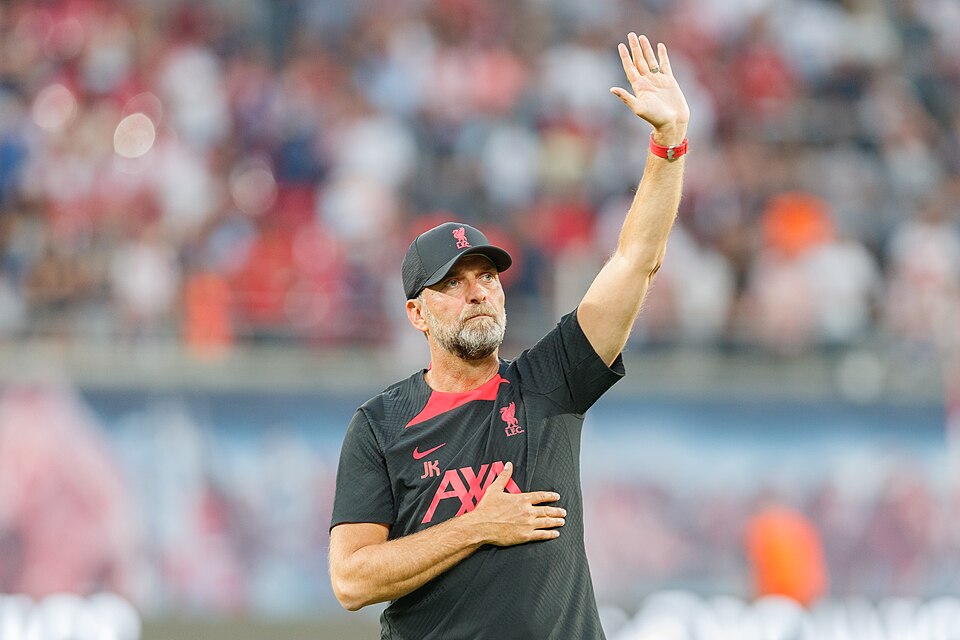
“I am running out of energy,” were the famous words uttered by the legendary coach Jürgen Klopp as he announced his departure as the head coach of Liverpool FC in January 2024, four months before the end of the season.
Then 56, Klopp had been in charge of the English side since October 2015 and managed to turn them into one of the most formidable forces in the world, lifting the UEFA Champions League and guiding them to their first Premier League title in 30 years.
For many, the German being in the dugout game after game, season after season, was a given. So, when he publicly declared his resignation over two years ago, a weary-eyed Klopp sent shockwaves through the football world. He had one of the best sides in the country and in Europe, yet he was stepping away.
Despite cries from the fans for him to return to the dugout, Klopp stayed true to his word. The man notorious for his “heavy-metal football” has yet to pick the guitar back up and is currently working as the Head of Global Soccer for Red Bull. Klopp recently went on the That Peter Crouch Podcast, admitting that he doesn’t miss it. “I can enjoy family, can enjoy spare time, go on holiday, but still work. At the moment, I miss nothing.” It’s safe to say that it’ll be a while before the four-time Champions League finalist puts his tracksuit and cap back on.
Klopp’s departure felt significant because it represented something bigger than one coach walking away from a football club. It highlighted the emotional and mental exhaustion that quietly exists throughout the modern game. Sir Alex Ferguson lasted 26 years in charge of Manchester United, while Arsène Wenger remained for 22 years at Arsenal. But now, football has become faster, louder and more demanding than ever before, and the people inside it are increasingly struggling to keep pace.
Quite often, managers are the public face of that pressure. Every result is analysed publicly, and every tactical decision is scrutinised online within 60 seconds. The modern-day coach is expected to lead training, handle the ruthless media duties, manage personalities and egos, oversee recruitment and manage upwards, downwards and sideways, while keeping fans onside. The role has evolved far beyond simply coaching football. However, this burnout has evolved to stretch far beyond simply the man in charge.
Behind the scenes, analysts, scouts, recruitment staff, academy coaches and even directors are operating in an industry that rarely slows down. Many will point to their sometimes obscene wages while playing the world’s smallest violin, but this is an obtuse view, and doesn’t represent the vast quantity who are actively working below the elite level, often for free, usually for very little monetary gain.
A scout covering multiple leagues may spend nights watching games from different time zones before waking up the next morning to compile reports. Analysts often work long after the final whistle, cutting clips and preparing presentations once the attention immediately shifts to the next opponent.
Even journalists themselves will admit to feeling burned out during notoriously busy periods of the football season. Early mornings, late nights, doing anything they can to get the next big story that will be digested by the insatiable appetite of millions.
The workload itself is demanding, but football’s culture can make things even harder. Breaking into the industry has become fiercely competitive. Thousands of aspiring analysts are building online portfolios, posting tactical threads and scout reports on platforms like X (formerly Twitter), hoping to stand out amongst the overpopulated crowd. Social media has undoubtedly opened many doors for those who otherwise would never have had the chance, but it has also created an environment where many feel pressure to constantly produce more work.
“I’ll watch one more match, scout one more player, write one more thread. If I stop now, someone else will get noticed.” Those starting out will be very familiar with this train of thought.
The line between passion and sheer exhaustion becomes blurred very quickly because most people enter the sport through genuine love for the game and a desire to make it to the top. Klopp, a man who once rallied an entire club under his guidance, could no longer motivate himself.
Watching football initially feels enjoyable rather than draining. Writing reports and analysing tactical details can be exciting at first. Over time, though, it begins to consume almost every part of daily life. Eventually, it becomes difficult to switch off entirely.
Social media has amplified this problem significantly. Matches happened at the weekend, mainly on a Saturday afternoon. Newspapers reported on it the next morning, and debate slowly faded before the next fixture. Once upon a time, discourse took place in middle-class cafes, originating in Vienna and Budapest, according to Jonathan Wilson in Inverting the Pyramid. Now, social media is the cafe, but it’s open 24/7, 365 days of the year. You can stay as long as you want and say whatever you like with little consequences. Well-thought-out opinions and debates will be drowned out by sheer noise.
Nowadays, the game never disappears. Podcasts, tactical breakdowns, endless transfer rumours and reactionary fan content continue around the clock. Football has become a 24-hour industry.
Supporters themselves are beginning to experience a form of burnout, too. Fans are no longer simply watching matches and having discussions in the pub anymore. We’re now constantly engaging with football through online discussion, clips, stats and heaps and heaps of content. Supporting a club can sometimes feel emotionally exhausting rather than enjoyable.
Every defeat is a crisis. Every managerial decision is either genius or incompetent. Every player is either overrated or underappreciated. Every transfer window creates months of speculation and anxiety for each stakeholder. Overnight, heroes become villains and villains become heroes – Klopp’s successor at Anfield is a prime example of this. Would the discourse around Arne Slot be so volatile if the same sequence of events had occurred 20 years ago?
Modern football culture also rewards constant engagement. All involved, including fans, are expected to stay informed on tactics, recruitment models and financial regulations in ways that would have felt unusual a decade ago. This has even become more prevalent in the post-COVID years. Just look at the reaction from the masses to Southampton’s recent “Spygate” scandal in comparison to Leeds United under Marcelo Bielsa in 2019.
In many ways, this has improved football discourse. Fans are more educated and tactically aware than ever before. But there is a downside to this constant immersion, as the sport we all love and pine over can begin to feel a little more like work than escapism.
This is especially noticeable during seasons with international tournaments. We consume domestic football – cups and leagues – European competitions, international breaks and endless media content in between. Ironically, football has never been more accessible, while also becoming harder to escape.
The sport’s obsession with optimisation contributes to this wider problem. Clubs search for marginal gains in every department, whether that be through data analysis, nutrition, artificial intelligence, niche coaching roles, psychology or tactical preparation. Every detail is put under the microscope in pursuit of improvement. While this has certainly raised standards, it has also created environments where people feel they can never truly disconnect. The wheel keeps on turning and turning, even if the driver constantly changes.
Klopp’s comments resonated so strongly because they felt honest in a ruthless industry that rarely encourages vulnerability. Elite football often celebrates intensity and sacrifice. Long hours are proof of dedication, and exhaustion is normalised since success is seen as worth any personal cost. Players and coaches cannot dare to be seen out on the town after a defeat. How dare they live their lives while I suffer.
But burnout eventually impacts performance. Tired coaches make poorer decisions, analysts lose perspective and ingenuity, and supporters can lose the joy that made them fall in love with football in the first place. That is the uncomfortable reality facing the modern game.
None of this means that football has become entirely negative. For many, it still remains deeply fulfilling. It’s an escape from the trials and tribulations of life. It still creates the highest of emotional highs and the lowest of lows. Yet, the industry surrounding football has become relentless, and the people inside it are increasingly feeling the strain.
Perhaps Klopp understood that before most. For nearly a decade, he was a God at Anfield Road. But eventually, one of football’s great motivators had nothing left to give. He bowed out, having left everything on the touchline. In many ways, his departure was not simply about one manager stepping away from one club, but it was a reflection of the wider pressures quietly building throughout modern football.
The challenge for the beautiful game moving forward may not be tactical innovation or smarter recruitment models. Instead, it may be preventing the constant emotional and mental demands of modern football from consuming the people around it. Klopp walking away from Liverpool was not shocking because he stopped loving football. It was shocking because one of the sport’s most energetic figures openly admitted that even he had reached his limit. When will we reach ours?